Showing posts with label mortgage broker. Show all posts

Saturday, June 28, 2014

MortgageDirect2u Mortgage Rates for June 28, 2014

Mortgage Rate Specials:

3 Year Fixed Mortgage Rate - 2.49%
5 Year Fixed Mortgage Rate - 2.95%
5 Year Variable Mortgage Rate - 2.35% (Prime - .65)

OAC E&OE


6 Month 1 Year 2 Year 3 Year 4 Year 5 Year
Posted Bank Rates 4.00% 3.09% 3.04% 3.44% 3.94% 4.79%
Canada Bond Rates 1.14% 1.22% 1.60%
Fixed Rates 3.95% 2.89% 2.59% 2.49% 2.87% 2.95%
Variable Rates 2.35%
Quick Close Rates 2.95%
No Frill Rates 2.85%
Cash-Back Rates 4.75%
HELOC Rates 3.50%

Mortgage Solutions Available From MortgageDirect2u

Residential Mortgage
If you are ready to close on your next home, let us arrange the mortgage financing on your behalf.  With electronic access to over 60 lenders we will ensure that you receive the best rate for the product of your choice, usually within 24 hours!


First Time Buyer
Are you a first-time buyer?  The residential property you are about to purchase is probably the largest single purchase, and biggest investment decision you have had to make in your life so far.  Let us help you through the confusing maze of lender options, terminology and mortgage documentation.

Debt Consolidation
Have you hit a credit crunch?  High interest debt on credit cards can create a lot of stress.  If you are finding there is more month than money, then perhaps it's time to review your debt situation and consolidate your high interest debt into one low manageable monthly payment.

Equity Take-Out
If you have been living in your home over the past 5 years, you have probably had your net worth increase by a substantial amount.  The problem is that net worth is not very liquid.  If you are ready to invest in your own small business, or you need to fund your daughter's university tuition, your home equity can be a ready source of cash to finance your dreams.

Mortgage Renewal
Is your mortgage up for renewal?  Do you want to be sure you are getting the absolute best mortgage rate in the market today, the rate you deserve?  Contact us today!

Personal Line of Credit
We can arrange a convenient personal line of credit at very competitive rates secured against your residential property.

Business for Self Alt-A
Business for self financing allows clients who cannot provide traditional income verification, such as the self-employed or 100% commissioned salespeople, to qualify for a high ratio mortgage for purchase or refinance purposes.

Refinance
Allows you to access up to 95% of your home's current value; 
freeing up your cash for a variety of needs.

New to Canada
Allowing those who have immigrated or relocated to Canada to own 
their first home with as little as 5% down.

Draw Mortgages
Allows residential home builders and individual homebuyers to 
take advantage of insured progress advances while the property is
being built.

Commercial Projects
We have a number of both institutional and private lenders in our network that are available to fund commercial real estate projects in Ontario.

Saturday, June 21, 2014

Should you Give Your Child a Boost to Home Ownership?

With the financial demands of school loans, living expenses, and finding a career path, many young people struggle to purchase their first home. Often, parents and grandparents are very sympathetic. They’ve enjoyed the financial benefits of long-term home ownership themselves, and see how hard it is today to make that important first step into the real estate market. So should you give them a boost?

First, consider your own financial situation. Your first responsibility is to your own financial security, so you need to consider what kind of help you can afford. If you loan the money and it is never repaid, will it affect your own financial security?  Can you afford to gift the money, and if so, how much?

Take some time to think about family dynamics.  Are there siblings or other family members to consider? Will there be an issue of fairness that you need to manage? Some families work well with a structured loan arrangement with a modest interest rate that gives the young family member an opportunity to buy the home – but also sets out the expectations for loan repayment. It can foster good borrowing habits and minimize family friction later.

Home ownership is a big financial responsibility. You know there are more costs to homeownership than just paying the monthly mortgage payment:  like heat, hydro, insurance, cable, taxes, and of course repairs and upkeep. Before you offer your child a boost to home ownership, consider whether they’re ready for the financial responsibility. Sometimes, the best advice is to keep renting for a while and take more time to get ready for the responsibility of a large mortgage.

If your child is married or living with a partner, consider property law. Experts advise parents to structure a loan to a child if there is a spouse or partner to consider. Should a marriage break up, for example, you may discover that 50 per cent of the money went free and clear to your child’s partner as part of a settlement of family property. A fairly simple fix is to structure a loan – even with 0% interest or with no regular payments – but with the ability to call the loan at any time.  In that way, the loan would be subtracted from the family property before being divided.

Always put it in writing. If it’s a loan, you’ll want a written record of your shared expectations. If it’s a gift, you must put it in writing for the lender that the child is not required to pay the money back at any time
. 
Talk to us! Your child is preparing to embark on an important financial journey, and you want to do your best to help get them on the right path. The best place to begin is with sound, expert advice.  Start them on a good financial habit and send them to us for access to the most mortgage options and clear-eyed, common sense advice.

What is Your Credit Score?

Credit scores can range from 300 to 900 and are used by lenders to determine what kind of a risk you are likely to be as a borrower. Your score is based on several attributes -
Payment history 

The single biggest factor in your credit score is having a timely bill payment history. Recent late payments are factored more heavily than old ones so start today and never let a bill get past due. 

Amounts owed
Keeping your accounts near their maximum limit can signal that you don’t manage credit responsibly, and that you may have trouble making payments in the future. 

Length of credit history 
The longer you have had credit in good standing, the better. Keep your oldest cards; that good history will help you, and don’t regularly take out new credit accounts. 

Pursuit of new credit 
Opening several credit accounts in a short period of time is a risk factor.  How many enquiries done on your behalf can also have an effect on your score.  

Types of credit 
A healthy mix of credit i.e. car loan, mortgage and credit card is more positive than a concentration of debt in only credit cards.

With an excellent credit score (750 and over), lenders will give you a quick mortgage approval at the best possible rates. This score says you are reliable and responsible with debt. At a lower score (below 620), you likely won’t get the best mortgage rates, you may require a larger down-payment, there could be extra fees, and you may even find it difficult to qualify.
  
Your credit score can change from month to month, which means you can boost your score relatively quickly with the right credit behaviours. We can review your situation and discuss how your score will be viewed by lenders and, if necessary, outline your best options for credit improvement. If you want to get a mortgage while you work on bettering your score, we can also advise how that may be possible.  

Friday, June 20, 2014

Why Use a Mortgage Broker?


A great rate is important – but it’s all the other terms that add up to a great mortgage.  Most people assume the lowest rate means the best mortgage.  Banks know it – that’s why they display their rates in large numbers everywhere you look.  A mortgage broker understands that rate is only one aspect of the mortgage, and that negotiating other terms to your advantage will maximize your savings in the long run.  We’ll help you get the whole package – a great rate plus the best amortization schedule, payment frequency, flexible repayment terms, transferability, and more so you don’t find yourself trapped with huge penalties if your needs change.

Applying for mortgages with several banks can harm your credit rating.  Many people are surprised to learn that skipping payments isn’t the only way to damage a credit rating – the truth is, you weaken your credit rating with every application you fill out.  This is because each bank pulls a credit bureau on you to assess your application and these inquiries are reflected on subsequent bureaus.  Many lenders consider multiple inquiries to be a red flag on your credit.  A good credit rating is critical in getting the best mortgage rate and terms.  A mortgage broker protects your credit by pulling just one credit report and submitting it to lenders on your behalf.  This way you can shop for the best possible mortgage amongst many lenders without damaging your credit rating.


A mortgage broker can often negotiate a better deal than you can.  Don’t take this personally – it’s not necessarily a reflection on your negotiating skills.  Thanks to industry affiliations and memberships, mortgage brokers have access to discounts that aren’t available to the general public.  Plus, experience tells us which terms lenders will flex on, so we can shape a mortgage to your exact needs.  One note of caution, however: once you start an application personally, a mortgage broker can’t step in and negotiate you a better deal with that same bank.  That’s why it’s important to let your mortgage broker handle the process from start to finish.


A pre-approval isn’t a commitment from your bank – it’s just an indicator of what you can afford should you be approved.  A pre-approval is a clever marketing tool on the part of banks.  It appears as though the bank has promised to fund your mortgage once you’ve found a house in your price range.  The reality is, it’s only a promise to hold a rate for you within a certain time frame – you still need to qualify for the mortgage once the time comes to purchase your home.  The last thing you want when you’ve found your dream home is to lose it because the bank is dragging its heels or offering different terms than you expected.  A mortgage broker can help ensure a smooth process from start to finish, so you won’t experience any nasty surprises - just the excitement of purchasing your new home.


There’s a world of mortgage products the average person doesn’t know about.  Most people aren’t aware that banks offer only a fraction of the mortgage products available.  A mortgage broker, however, is an expert on the different products and lenders in the industry and stays abreast of changing market conditions.  That knowledge can be invaluable in finding the best mortgage for your needs.  Self-employed?  New to Canada?  Looking to buy a rental property?  A mortgage broker can help you qualify for specialized mortgage products like these and many more.


There’s more to most variable rate mortgages than meets the eye.  Just like mortgages, people typically fall into two categories: Variable Rate or Fixed Rate.  “Fixed rate” people feel most comfortable when they know their exact mortgage payment at all times.  “Variable rate” people are willing to experience the uncertainty of their payment amount in exchange for the savings that come with it Variable rate terms and conditions can be quite complex, however.  A mortgage broker has the expertise to sort through the conditions, explain their implications to you and help you find the right variable rate mortgage for you.


Your mortgage broker works for you, not your lender.  When you visit a bank, the representative’s job is to recommend their mortgage products to you, regardless of whether they really suit your needs.  A mortgage broker, however, has no such mandate – our only job is to ensure you get the best mortgage possible.  Think of it this way.  You probably wouldn’t buy a house without the advice of a real estate agent.  Nor would you close the sale without a lawyer.  Why?  Because they’re specialists in the field of home buying – they know the right questions to ask and the proper steps to take to minimize the risk that you’ll regret your purchase later. 


MortgageDirect2u

http://www.mortgagedirect2u.ca
416-275-9284

Thursday, June 19, 2014

Buy and Renovate Mortgage


Many home-buyers looking at older properties find themselves in a common predicament: they have found a property that suits them, but it needs some costly and immediate upgrades. 

Many buyers add the costs of those immediate renovations into their mortgage, instead of racking up credit card bills or selling investments to pay for the upgrades.  Known as a “purchase plus improvements” mortgage, this type of mortgage covers the sale price of the home, plus any renovations that would increase the value of the property, with as little as 5 per cent down.   

If you’re buying a home but want to add a second storey, finish a basement or redo a kitchen, it can make a lot of sense to add those costs to your mortgage.  That way you can spread your payments over the life of the mortgage and have a cost-effective way to get your dream home.  You can also use your pre-payment privileges to pay the renovation off faster.  The process is quite simple:

Obtain cost estimates for the upgrades
Once you have found a home, you need to get detailed written quotes from licensed contractors on the renovations you plan, outlining the scope and all costs.

Get your appraisal
An appraisal with two separate values will be required: first the value of the property "as is" and the estimated value of the property once the improvements are completed.

Renovation costs are included in your mortgage
Your lender will add the estimated costs of the renovation into your mortgage.  For example, with a 5% down payment, your mortgage broker would apply for 95% of the “as improved” market value, which will be higher than the actual purchase price.  The committed amount of the mortgage will be advanced to your solicitor, who will be instructed to hold back the renovation funds until the work has been completed and inspected.

Complete your upgrades; funds are released upon completion
Once an inspection from an appraiser confirms all work is complete and a copy of the building permit (if applicable) has been received, the balance of the mortgage funds will be released to you to pay for the renovations. There are a few options for carrying your expenditures until the funds can be released.  Some major home improvement retailers offer “no payment” options for up to six months.  Larger contractors may also be willing to finance the project short-term if they see the documentation for purchase plus improvements financing. 


Example:
Purchase price:    $400,000
Improvements:      $40,000
Total mortgage:   $418,000 (95% of $440,000)
$378,000 will be released on closing date. $40,000 will be released upon completion of improvements i.e. improvements are 100% complete and a final inspection has taken place.  

Be sure to consult with a mortgage professional to learn about the full range of options available to you when purchasing a fixer upper.


Thursday, June 12, 2014

CMHC Guarantee on Mortgage Insurance Putting Taxpayers at Risk: OECD

TSX -12.25 to 14,892.13 (CP)  the indexes took a breather from the near record levels hit in the last few sessions

Dow -102.04 to 16,843.88 The World Bank has said it plans to cut its 2014 global growth forecast to 2.8 per cent from 3.2 per cent, citing a bitter American winter and the political crisis in Ukraine. However, recent data such as solid U.S. hiring and stronger Chinese exports in May suggest prospects for growth in the second half of the year aren't all pessimistic
     
Dollar +.03c to 91.71cUS
 
Oil +.05 to $104.40US    amid a report from the U.S. Energy Department that oil supplies fell by 2.6 million barrels in the week ended June 6, more than double the 1.2 million barrels analysts expected.

Gold +$1.10 to $1,261.20US
 
Canadian 5 year bond yields markets  +.0 to 1.60.  The spread (obtained by subtracting the bond yield above from the industry average 5 yr rate Published mortgage rate of 3.29) is just below the profit range at 1.69. If the increase in bond yield continues upward, the spread shrinks, which could prompt interest rates to rise. The range for investor desired profitability is currently a bit lower in the region of 1.75 and 1.95. Investors are currently accepting far below to achieve market share in spring market


CMHC guarantee on mortgage insurance putting taxpayers at risk: OECD

Julian Beltrame, The Canadian Press

OTTAWA - The federal government needs to limit the percentage of a mortgage loan it is willing to insure in order to protect taxpayers if the overheated housing market goes bust, according to a new report on Canada by a major international think-tank.

In the first major survey of the Canadian economy in two years, the Organization for Economic Co-Operation and Development takes particular aim at risks in the housing market, while also chiding the country's environmental record, the oilsands and skills training.

The report — which contains a dedication to the late finance minister Jim Flaherty from the group's secretary general, Angel Gurría — is mostly complimentary about the state of the Canadian economy but raises a number of concerns, including growing inequality, the two-speed economy and Canada's environmental record.

It takes special aim at the housing market, particularly increasing unaffordability in certain big cities like Vancouver, and high household debt which leaves families vulnerable to interest rate hikes.

"Almost 40 per cent of the country’s population lives in a city where house prices are seriously or severely unaffordable," it states. "A shock to even one segment could have spillover effects to the broader economy if banks respond by tightening credit significantly or if negative wealth effects depress consumption."

Given such risks, the OECD wonders why the government allows Canada Mortgage and Housing Corp. to insure 100 per cent of high-leverage mortgages when most other countries limit potential losses to 10 to 30 per cent of outstanding balances.

"Imposing a deductible on mortgage insurance, as is common in other lines of insurance, would help promote stability by better aligning the interests of the lenders and those of the insurer, thereby reducing moral hazard," it recommends.

"Over the longer run. the insurance activities of CMHC could be privatized, shifting the government's role to one of guaranteeing only against catastrophic losses," it added.

Speaking to reporters at International Economic Forum of the Americas in Montreal, Gurria said he wasn't overly worried about a housing market crash in Canada.

"The concern more than a crash is about affordability," he said.

Former finance minister Flaherty had also speculated about privatizing the Crown corporation, and Ottawa has taken steps to rein in its activities, including the most recent announcement that it would no longer insure condominium construction. It has also dropped insurance on second homes.

One danger of the government-backed safety net is that lending standards are reduced since banks are protected against default.

Finance Minister Joe Oliver has come under pressure to intervene in the market after recent moves by Canadian banks that have taken five-year fixed rates below three per cent. But, speaking in New York, the minister downplayed the danger saying rates had not come down very much.

"We don't believe there is a major problem," he said.

The wide-ranging report analyses most economic and fiscal issues facing the country and expresses concern over the lack of skilled workers for some sectors in some regions, particularly resource-rich Alberta and Saskatchewan.

In a separate paper, the OECD says federal and provincial governments must co-operate with local authorities and schools in educating and training Canadians for the jobs that are in demand.

"Skills shortages in certain fields and regions could limit growth going forward," it warns, adding that the average apprenticeship completion rate was only 50 per cent between 2000 and 2011.

The OECD says some of the problem could be ameliorated by better data on job vacancies — a point made again Wednesday by economist Don Drummond in a paper for the Institute for Research in Public Policy.

In the Commons, opposition MPs criticized the government for slashing funding on labour information gathering by 20 per cent, saying it shows the government's is not interested in reliable data to guide its Temporary Foreign Workers program.

The OECD was also critical of Canada's environmental record, calling the expansion of the oil sands in Alberta the principal reason the country won't come close to meeting its 2020 target on reduction of greenhouse gas emissions. That's because oil sands expansion is projected to increase oil and gas emissions by 23 per cent by 2020.

It recommends that Canada increase the pricing on carbon emissions, noting that currently it has one of the lowest effective tax rates on carbon among industrialized countries.

"We are on a collision course with nature," Gurria said of the report's findings. "We cannot sustain long-term growth in our economies if we do not protect and preserve our environment."

Generally, the OECD says Canada's economy is doing relatively well with expected growth rates of 2.5 per cent this year and 2.7 per cent in 2015.

But it warns that inequality is rising and that it is increasingly becoming a two-speed economy, as Bank of Canada governor Stephen Poloz has described it, with resource-rich regions doing well at the expense of other regions.

"The emergence of low-cost competitors in emerging economies and exchange-rate appreciation resulted in slower growth in the manufacturing-based economies of Ontario and Quebec," it said.

It didn't limit its criticism only to the federal government. The OECD also chided oil-producing provinces for not taxing its producers sufficiently and for not socking away enough of the revenues from non-renewable resource extraction for future generations, as Norway has done.

Tuesday, May 20, 2014

Six Things to Know about Real Estate Deposits

TSX -74.15 to 14,514.74 (CP)  Resource and financial companies were the main culprits as traders wondered if economic conditions warranted further moves up for stocks.  
Dow +44.50 Fri +20.55 Mon to 16,511.81    U.S. indexes registered gains amid a disappointing read on consumer confidence but a strong showing for housing starts.
Dollar +.17c to 92.11cUS  
Oil +.52 to $102.02 US  
Gold -$.20 to $1,293.40US
 
Canadian 5 year bond yields markets  +.01 to 1.54.  The spread (obtained by subtracting the bond yield above from the industry average 5 yr rate Published mortgage rate of 3.29) has leapt back into the profit range at 1.75.  If the increase in bond yield continues upward, the spread shrinks, which could prompt interest rates to rise. The range for investor desired profitability is currently a bit lower in the region of 1.75 and 1.95. Investors are currently accepting far below to achieve market share in spring market


Six things to know about real estate deposits

When you make an offer on a house you have to put down a deposit. Here are some things to keep in mind.


Mark Weisleder Real Estate, Published on Fri May 16 2014

Here are some answers to common questions about deposits when you are buying a house.

When must a deposit be paid?

In Ontario, the standard real estate contract gives the buyer two choices; you can pay the deposit immediately when you make an offer, or you can agree to pay it within twenty four hours after the seller accepts it. Most buyers prefer the second option. If you are in a bidding war, you will be encouraged to come up with the deposit immediately, to show good faith to the seller.

Can the buyer get out of a deal by refusing to pay the deposit?

No. Once the deal is accepted, you can’t change your mind. If you do, the seller can sell the property again and if he gets less money than you were going to pay the seller can sue you for the difference, plus legal fees.

What happens if the deposit is paid late?

The seller has the right to cancel the deal. This is because all time limits matter in a real estate contract and if you are late, even by a few minutes, the seller can try and cancel. I have seen this happen many times, especially when the seller knows that there is another buyer out there who will pay more money. If you need more time to come up with your deposit, say so in your offer.

How much should a buyer pay as a deposit?

This is a tough question, and will largely depend on where your home is located. In Toronto, deposits are now usually up to 5 per cent of the sale price. In Brampton, it is closer to 2 per cent. In some areas of Ontario, deposits can be as little as a few hundred dollars.

Why does the deposit go to the seller’s real estate agent and not the seller?

If the seller goes bankrupt or disappears with the deposit, the buyer is not protected. When the deposit is held by the real estate brokerage, it is in trust and is also protected by insurance so even if the brokerage goes bankrupt, the buyer can get their money back.

If the buyer is unhappy with their home inspection, can the seller refuse to return the deposit?

This happens more than you think. A deposit cannot be released unless both the buyer and seller agree. If a seller believes the buyer did not act in good faith in trying to satisfy their condition, whether it is a home inspection, financing or a condominium status certificate review, they can refuse to release the deposit. This means it stays in the broker’s trust account until a judge decides who gets it, which can take years. As a precaution, buyers should consider making two deposits in their offer, a small one of say one per cent when the offer is accepted, and a second larger deposit once the condition is satisfied.

Understand the rules about deposits before you sign any real estate contract. It is expensive to change your mind later.

Monday, May 12, 2014

Real Estate Regrets: What new homebuyers wish they had done differently!

TSX -11.97 to 14,534.06 (CP) as unexpectedly sluggish jobs data and worries about escalating tensions in Ukraine spurred declines in the energy and financial sectors.  
Dow +32.37 to 16,583.34    
Dollar -.62c to 91.78cUS  as Statistics Canada reported that the economy cut 28,900 jobs in April against expectations of a gain of about 12,000. It was also a huge turnaround from the previous month when the economy cranked out 43,000 jobs, which means just 14,000 jobs were added over the two-month period. The unemployment rate held steady at 6.9 per cent
Oil -.27 to $99.99 US  
Gold -$.10 to $1,287.60US
 
Canadian 5 year bond yields markets  -.03 to 1.62.  The spread (obtained by subtracting the bond yield above from the industry average 5 yr rate Published mortgage rate of 3.29) has moved well below  the profit range at 1.67.  If the increase in bond yield continues upward, the spread shrinks, which could prompt interest rates to rise. The range for investor desired profitability is currently a bit lower in the region of 1.75 and 1.95. Investors are currently accepting far below to achieve market share in spring market


Real estate regrets: What new homebuyers wish they had done differently

Hal M. Bundrick | MainStreet.com – 6 May, 2014

You wanted a home with a pool but got a porch instead. A big back yard? No, you went with brick back yard just a bit bigger than your grill. What seemed to be a quiet neighborhood during the Sunday afternoon open house turned out to be because the neighbors were sleeping off their every-Saturday-night booze and brawl. Real estate regrets are many, and homeowners are quick to admit what they should have done differently.

Nine out of every ten buyers felt prepared when they bought their home, but after the fact, well more than half (56%) wish they had known more about the financial process involved in buying a home. The loan closing process was at the top of the should-have-known-more list (22%), followed by making an offer and negotiating (19%) and financing (15%), according to a new survey by Chase.

Nearly four in ten (39%) said that knowing what they know now, they would have bought a different-size or different-priced home, perhaps even in a different neighborhood. Most recent homebuyers were surprised by how long the purchase process took, too: 40% said it took longer than they expected.

More than one-third (34%) said owning a home cost more than expected. And while more than 80% of buyers considered their home move-in ready, nearly as many (76%) now admit they've done, or are planning to do, renovations to their home soon.

A survey fielded one year ago by Trulia found similar results. More than one third (34%) of homeowners with regrets responding to a March 2013 poll said they wished they had chosen a larger home.

Other regrets included:

• Wish I had done more remodeling on the home than I did (27%)
• Wish I had more information about the home before I decided (22%)
• Wish I had made a larger down payment (18%)
• Wish I had been more financially secure before buying (16%)
• Wish I had chosen a home with a shorter commute to work (15%)

It seems buyers may find fewer homes to choose from combined with higher prices this year. Pending home sales rose in March, the first gain in nine months, according to the National Association of Realtors. While home sales are expected to trend up for the balance of the year and into next, NAR expects total sales to fall below last year's pace, with existing-home sales predicted to total just over 4.9 million this year – well below the nearly 5.1 million sold in 2013. But, with ongoing inventory shortages in much of the nation, median existing-home prices are expected to rise between 6% and 7% this year.

Monday, May 5, 2014

Private Mortgage Insurers Opt Not to Match CMHC’s Cuts

Canadian 5 year bond yields markets  -.01 to 1.63.  The spread (obtained by subtracting the bond yield above from the industry average 5 yr rate Published mortgage rate of 3.29) has moved well below  the profit range at 1.66.  If the increase in bond yield continues upward, the spread shrinks, which could prompt interest rates to rise. The range for investor desired profitability is currently a bit lower in the region of 1.75 and 1.95. Investors are currently accepting far below to achieve market share in spring market


Private mortgage insurers opt not to match CMHC’s cuts

TARA PERKINS - REAL ESTATE REPORTER The Globe and Mail  May. 02 2014

Canada’s two private-sector mortgage insurers have decided not to match all of Canada Mortgage and Housing Corp.’s recent product cuts.

Genworth MI Canada sent a letter to banks Friday saying that it will not be making any changes to its standards for self-employed borrowers.

Genworth will, however, tighten its rules for second homes slightly. As of May 30, it will only sell second-home mortgage insurance on homes with one unit in them, rather than two (such as duplexes or a self-enclosed apartment in a house).

Up until now, Genworth has been willing to insure second homes with two units, as long as one of those units was occupied by the mortgage holder or one of their immediate family members.

Canada Mortgage and Housing Corp. (CMHC) said last week that, as of May 30, it will stop insuring mortgages on second homes and will stop offering mortgage insurance to self-employed people who don’t have standard documents to prove their income.

“There will be no amendment to the maximum number of Genworth-insured properties per borrower,” Genworth said in its letter to lenders.

Canada Guaranty, the country’s third-largest mortgage insurer, is similarly limiting its second-home insurance to one unit, but not changing its rules for self-employed borrowers.

Mortgage insurance is mandatory in Canada for federally-licensed lenders when a borrower takes out a mortgage with a down payment of less than 20 per. The insurance pays the bank back if the borrower defaults on their loan.

Wednesday, April 16, 2014

New Mortgage Guidelines push CMHC to Embrace Insurance Basics

Canadian 5 year bond yields markets  +.02 to 1.66.  The spread (obtained by subtracting the bond yield above from the NEW lower industry average 5 yr rate Published mortgage rate of 3.29) has moved well below  the profit range at 1.63.  If the increase in bond yield continues upward, the spread shrinks, which could prompt interest rates to rise. The range for investor desired profitability is currently a bit lower in the region of 1.75 and 1.95 . We learned at the Ontario PD Day yesterday from EVP John Bordignon of Paradigm Quest, that spreads are a full 30-40bps lower than desired and rates should be closer to 3.39% right now. Spring Market has influenced a much smaller profitability level, but don’t expect it to last.

New mortgage guidelines push CMHC to embrace insurance basics

John Greenwood | April 14, 2014 | Financial Post

The Canada Mortgage and Housing Corp. was created by the federal government nearly 70 years ago with a mandate to help smooth the way toward home ownership for millions Canadians who might not otherwise achieve their dream.

As a tool of social policy the CMHC has done a pretty good job, but when it comes to market discipline, maybe not so much. In fact critics say that by pursuing its social policy goals so zealously it has distorted the country’s real estate market, helping to push up prices to record levels.

Now Canada’s financial regulator wants to fix the problem.

After two years of planning, the Office of the Superintendent of Financial Institutions on Monday released a set of draft guidelines for mortgage insurance providers aimed at tightening standards around underwriting and risk management.

The proposed rules essentially tell mortgage insurers to pay attention to the basics of their business, like ensuring that the banks they deal with maintain strong lending practices and that the insurance purchasers have good credit quality. It sounds like business 101, but the very fact that OSFI felt it needed to bring in the rules suggests things in the mortgage insurance market were not as they should be.

In a statement, OSFI said the so-called Guideline B-21 rules will “provide clarity about best practices in respect of residential mortgage insurance underwriting, which contribute to a stable financial system.” The long-awaited rules — the regulator first revealed it was developing new standards back in April 2012 — are open for public comment until May 23.

They’re built around several basic areas, including governance and underwriting practices, standards for assessing mortgage lenders, and criteria for determining insurable loans.

The mortgage insurance industry consists of just three companies: the CMHC, which controls the bulk of the market, Genworth MI Canada and Canada Guaranty.

Their policies are backed by Ottawa, and ultimately by the taxpayer.

Perhaps more than anything else, the guidelines put players on notice that they must do a better job of maintaining business discipline and handling risk, and that they will be subject to much closer scrutiny by OSFI.

The bill establishes a framework where regulators “would be responsive to a market where there was more risk-based pricing,” said Finn Poschmann, vice president of research at the CD Howe Institute.

One section that’s garnering much attention in the mortgage industry is a section on down-payments required to qualify for insurance.

As it stands, borrowers who are unable to put down a minimum 20% of the price of a house must purchase default insurance. In the past, some lenders have given the green light to borrowers with no down-payment as long as they bought insurance. They did that by offering certain types of cash-back mortgages. The new guidelines would eliminate that loophole.

“A federally regulated mortgage insurer should establish minimum down payments, as well as acceptable sources of down payment in its criteria,” according to OSFI’s draft document. “In particular, the [insurer] should specify where traditional sources of down payment (e.g., borrower’s own equity) are required and cases where non-traditional sources for the down payment (e.g., borrowed funds) may be used… Incentive and rebate payments (i.e., “cash back”) should not be considered part of the down payment.”

As well, mortgage insurers will be required to consider “acceptable methods” for determining the credit history and quality of borrowers. They will also have to closely scrutinize lenders’ methods of income and employment verification.

Of the roughly $1.2-trillion of Canadian home loans outstanding, more than half are covered by government-backed insurance underwritten either by the CMHC or one ofthe two smaller providers.

Critics argue that the easy availability of such insurance has significantly boosted the number of potential buyers, pushing up prices and adding froth to the market.

For the past several years, the federal government has been closely scrutinizing the CMHC, with former Finance Minister Jim Flaherty musing publicly as far back as 2012 about privatizing the Crown corporation.

Observers compared this latest move to an earlier set of guidelines focusing on banks’ mortgage underwriting processes. OSFI’s B-20 Guideline, presented in draft form in April 2012, included set of principles around mortgage lending that put responsibility for underwriting standards on the shoulders of banks and their top executives.

Observers say the move helped cool a housing market that appeared to be bubbling over.

How Rent to Own Houses Work in Canada

TSX +19.49 to 14,303.92 (CP) a small gain amid concerns about China's growth and worsening tensions between Ukraine and Russia.  
Dow +89.32 to 16,262.56  Worries about the Ukraine crisis deepened after the government's first military action since acting President Oleksandr Turchynov announced an “anti-terrorist operation” against separatists who have seized control of numerous buildings in the east of the country.     Concerns about China also weighed as data showed a tightening of credit growth. Money supply growth was up just 12.1 per cent year over year in March, the slowest pace in 17 years.
Dollar -.20c to 91.10cUS    a day ahead of the Bank of Canada's latest interest rate announcement. It is universally expected that the bank won't hike its key rate from one per cent, where it has been since Sept, 2010.
Oil -.30 to $103.75 US   Concerns about China also weighed as data showed a tightening of credit growth. Money supply growth was up just 12.1 per cent year over year in March, the slowest pace in 17 years.
Gold -$27.20 to $1,300.30US
 
Canadian 5 year bond yields markets  -.03 to 1.63.  The spread (obtained by subtracting the bond yield above from the NEW lower industry average 5 yr rate Published mortgage rate of 3.29) has moved well below  the profit range at 1.66.  If the increase in bond yield continues upward, the spread shrinks, which could prompt interest rates to rise. The range for investor desired profitability is currently a bit lower in the region of 1.75 and 1.95 . We learned at the Ontario PD Day yesterday from EVP John Bordignon of Paradigm Quest, that spreads are a full 30-40bps lower than desired and rates should be closer to 3.39% right now. Spring Market has influenced a much smaller profitability level, but don’t expect it to last.
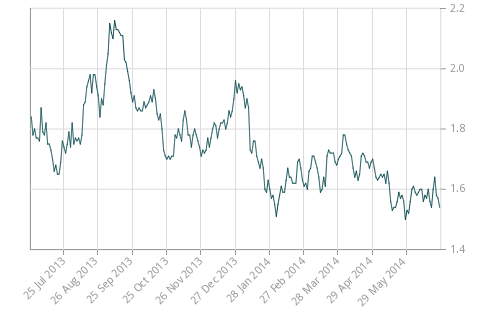
http://www.marketwatch.com/investing/bond/tmbmkca-05y?countryCode=bx


How Rent to Own Houses Work in Canada

Written by FrugalTrader on Jul 9, 2012 filed under Real Estate

One real estate strategy that I’m quite familiar with, but never written about, is rent to own or lease option homes.  What is a rent to own home?  It’s pretty much exactly as it sounds.  It’s where an investor, or home owner, rents out their property to a tenant, but gives the tenant the “option” to purchase the home after a certain period of time at a predetermined price.

Home owners sometime use this strategy as an incentive to get their home sold, even if it means taking payments for a certain period of time.  Home buyers with not so great credit, and low amount of savings for down payment,  may find this method of financing attractive.  It enables them to get into a home right away, while building their credit and down payment through rent credits.

For the investor, selling a house via rent to own or lease option is very similar to selling a covered call.  The tenant has to pay the investor an upfront “premium” for the option to purchase the house, this is called the “option deposit”.  At the expiry, which is negotiated between the investor and tenant, the tenant has the option of purchasing the house at a predetermined price.  The option deposit, along with any rent credits, are used as part of the down payment on the house.

How does rent to own work?

House is listed as a rent to own with monthly rent at the high end of rentals in the area, and a small option deposit (1-2% of property value).  The option deposit goes towards the purchase of the home and is non-refundable.
Tenants are screened for decent credit, employment and potential for purchasing home at end of the term.
Tenant moves in, landlord collects rent and option deposit upfront.  A separate lease and purchase agreement is signed.
A small portion of the rent, called a rent credit, is put against the purchase price of the home.  The rent credit is at the discretion of the investor.
If the tenant decides not to buy, the tenant loses their option deposit and rent credits.
Investors Perspective

Benefits

Rents are typically higher;
Option deposit collected upfront;
Tenant is responsible for maintenance and repairs;
Tenant typically treats the home as if it is their own; and,
Guaranteed sale price if tenant exercises their option.
Negatives

Setting a ceiling on selling price of the house, especially in appreciating markets;
The initial due diligence required to screen tenants; and,
Tenants can walk away from the deal at any time, but investor is bound by terms of the purchase agreement.
Tenant Perspective

Benefits

Tenants can “test” the house and the neighborhood and can walk away from the deal at any time.
Tenants with mediocre credit can build their credit over the term and build their down payment via rent credits.
Negatives

Tenant pays premium rent for the “option” to purchase the house.  If the tenant decides not to buy, the option deposit is lost.
Bank financing is not guaranteed at the end of the term.
Final Thoughts

From an investors perspective, this is one way to make money via real estate, however, placing a cap on the selling price is the deal breaker.  Personally, I’d rather build equity over time and keep the property for the long term.  However, I can see this being a viable solution for home owners who are having trouble moving their home in a buyers market.

Do you have any experience with rent to own homes in your area?

Thursday, April 3, 2014

Mortgage before May: Rising mortgage insurance premiums bump up costs

Mortgage before May: Rising mortgage insurance premiums bump up costs

If you’re in the market for a mortgage, and have less than 20 per cent down payment, then you might want to get that mortgage before May.

For the first time in more than a decade, Canada Mortgage and Housing Corporation (CMHC) is raising premiums for insuring mortgages on Canadian homes: an average 15 per cent.  A crown corporation, CMHC is Canada’s largest mortgage insurance provider. Private insurer Genworth has followed suit with a matching increase in premiums.

How does it hit your wallet? A home buyer with a $248,000 mortgage and a 5 per cent down payment will pay an extra $5 per month in insurance premiums. Your mortgage broker can calculate exactly how much the increase will mean to you.

Canadian homebuyers are required to have mortgage insurance if they have less than 20 per cent equity in their homes. The insurance provides protection for the lender in the case of a default. In general, the system works well: Canadians have a vested interest in maximizing their down payment, and in building some equity in their homes, and a prudent mortgage insurance system has contributed to a stable mortgage market in Canada.

The last change in premiums was a decade ago: when CMHC actually lowered the rate.  Experts say the increase in premiums is probably overdue – as insurers must hold adequate capital reserves.

Will this be the last increase for the next ten years? CMHC expressed plans to announce its premiums in the first quarter of every year going forward. So stay tuned in early 2015 for any more news.

In the meantime, there’s no cause for alarm for Canadian home buyers.  But there is a strong incentive for homebuyers to visit their mortgage broker right away. The change will come into effect on May 1st.  Homebuyers will be able to access the current lower rates if they have bought a home and are approved before the May 1 deadline, even if they have a later closing date.

If you’ve got less than a 20 per cent down payment, then you owe yourself a visit to your mortgage broker now.

Friday, January 3, 2014

Mortgage Market Commentary for January 3, 2014

  • TSX -27.36 to 13,594.19 (CP) started the 2014 trading year in the red in the wake of manufacturing data that indicated the sector is still growing but at a slower pace.
  • Dow -135.31 to 16,441.35 as investors stepped back following strong double digit gains in 2013 despite further evidence that U.S. layoffs are low and hiring will likely remain steady. The Labor Department said that the number of Americans seeking unemployment benefits dipped 2,000 last week to a seasonally adjusted 339,000.
  • Dollar -.33 to 93.69US as the U.S. dollar gained against other currencies
  • Oil -$2.98 to $95.44 US two manufacturing surveys showed Chinese activity slowed in December. A strengthening greenback also depressed prices. That's because a stronger dollar makes commodities such as oil that are priced in dollars more expensive to buyers using other currencies.
  • Gold +$22.90 to $1,225.20 US TSX losses were held in check by a sharp uptick in the gold sector as bullion prices rebounded

Canadian 5 year bond yields markets +.01 to 1.93. The yield was 1.80 on Dec 18 and we’ve seen lenders start to increase fixed rates. The spread (obtained by subtracting the bond yield above from the industry average 5 yr rate published mortgage rate of 3.59) is well below the profit range at 1.66. If the increase in bond yield continues upward, the spread shrinks, which could prompt interest rates to rise. The range for investor desired profitability is currently a bit lower in the region of 1.80 and 2.00.

14 ways to slash your expenses in the new year

Teresa Mears | U.S.News & World Report

With the new year approaching, it's time to get your financial house in order.

No matter what mistakes you made in 2013, you get a do-over in 2014. The beginning of the year is a great time to make changes that will boost your bottom line going forward. But before you can make a plan to save money, you have to find out where your money's going. If you use an online budget tool or computer program to track your spending, run some reports and evaluate where your money went. If you don't have any records, write down every penny you spend for a month.

"It's hard to figure out where you're overspending until you know where you're spending," says Jean Chatzky, author of "Money Rules: The Simple Path to Lifelong Security."

Once you've got a record, do some analysis. The first question, obviously, is whether your outgoing funds exceeds your income. If you've got a mountain of credit card debt, and every month you spend more than you take in, you need make some changes.

"This can happen to smart people, to anybody, to responsible people," says Beverly Harzog, author of the new book "Confessions of a Credit Junkie: Everything You Need to Know to Avoid the Mistakes I Made." Her problems were caused by overspending when she was young, but others have ended up in debt because of job loss, medical problems or other issues beyond their control. Solving the problem, however, is up to them. "It is your problem and you have to fix it, regardless of how it happened," Harzog says.

Even if your expenses don't exceed your income, drilling down into your spending may reveal places you can painlessly cut costs to have more money for retirement, a home down payment or an exotic vacation.

The best spending plan for you may not be the best plan for your neighbor. We've all heard the cliché about cutting out the morning latte, but that isn't going to work for everyone, especially those who never buy lattes. "If you value that takeout coffee - if it puts a little joy in your day - I don't believe that's what you should cut," Chatzky says.

For some people, cutting out the morning latte won't make a dent. They may have to look at more painful cuts, such as moving to cheaper housing or choosing public rather than private schools. "Sometimes the little trims here and there aren't enough," Chatzky says.

Here are 14 ways to slash expenses in the new year:

Cook more at home. "We eat so frequently on the go these days," Chatzky says. "The evidence is gone before you get home." Anyone who can read can cook, and the Internet is full of websites with easy, healthy recipes.

Save on groceries by shopping store sales and using coupons. It's true that a lot of coupons are for junk food, but that doesn't mean you can't save with coupons, particularly on personal care and cleaning products. Store sales can provide even bigger savings. Many products go on sale every two, three or six months. Watch the sales cycles on products you use, and stock up when prices are lowest.

Look for happy hours and restaurant deals. For many people, drinks and dinner with friends are a big part of socializing. If you don't want to give that up but you want to spend less, find restaurants with 2-for-1 drinks and free or cheap appetizers and make those your dinner. Join restaurant email clubs to get coupons you can use to cut the price of restaurant meals.

Call your cable TV and Internet provider and ask for a better deal. As more users abandon cable and more competitors get into the market, companies want to hang on to customers. That means they're ready to make a deal. You'll get the best deals from the customer retention department, which is where you call to cancel. "The last time I did this, I saved close to $50 a month," says Liz Weston, author of "Deal with Your Debt: Free Yourself from What You Owe."

Investigate cheaper cellphone plans. Many carriers are offering new no-contract and pay-as-you-go plans. If you find a plan you like, and your contract is up, ask your existing carrier if it will match the price or give you a better deal.

Cancel your landline phone. Many people find they rarely make calls on their home phone. If you're not using it, why are you paying for it? Ask about bundling your phone with your cable and Internet service - but be warned that a cable phone will not work in a power failure.

Review your insurance costs. Call your insurance agent and make sure you're getting all the discounts to which you're entitled. Make sure your coverage fits your current circumstances. If your teenage driver moved out and got his own car, get him off your policy. You might also want to get quotes from other companies on auto or home insurance.

Call your credit card companies and ask for lower rates. Or do balance transfers. Credit is loosening up and card companies are sending more offers. If you get a good offer, call your existing company and see if it will match the new offer. If your credit is good and you make all your payments on time, you're in a good position to negotiate. "All they can do is say no," Harzog says. "Consumers have more power than they know."

If you are in debt, make a plan to pay it off. Paying $200 a month in interest charges is a waste of money that would be better used toward retirement savings, your kids' braces or a trip around the world. Some experts advise paying off the smallest balances first, although Harzog recommends targeting those with the highest interest rates. Either way, start paying off those cards, one at a time. Make the minimum payments on all cards, but target one card at a time and make bigger payments so you can pay it off. When you've paid off one card, go to the next.

Look for a cheaper health club. Are you paying $75 a month for a gym membership you never use? Maybe you should cancel and take up walking, biking or hiking. Perhaps you can get a gym membership that's equally good for half the price at a YMCA or community center. Shop around.

Look at the fees associated with your bank and investment accounts. If you don't have free checking, ask your bank what you can do to get it. If your bank doesn't offer free checking, find one that does. If mutual fund fees or stock account fees are eating into your returns, move your accounts to a discount brokerage, especially if you're not getting personalized advice.

Don't shop for recreation. If you're not in the stores, you won't be tempted to buy. That goes for yard sales and thrift shops, too, Weston says.

Be careful of online purchases. It's easy to shop online in the wee hours of the morning, but that spending can add up. Unsubscribe from email alerts that urge you to spend. Get yourself off stores' online mailing lists and restrict your online shopping to things you really need, when you need them.

Make a budget and stick to it. Give yourself a realistic allowance for discretionary spending and don't spend any more than that. "It sounds quaint," Harzog says, but having a budget works.

Thursday, January 2, 2014

Mortgage Market Commentary January 2, 2014

Happy New Year!
  • TSX +40.16 to 13,621.55 (CP) as investors closed the books on a year that saw a solid advance, up 9.55 per cent for the year, with the advance racked up over the last five months. The market started to transition from one that was driven by central bank stimulus to an environment where investors started to focus more on economic fundamentals.
  • Dow +72.37 to 16,576.66 also ended the year at a new high, as traders digested a mixed bag of data on home prices, consumer confidence and manufacturing. For the year, U.S. home prices reflected big gains in earlier months. They rose 13.6 per cent over the past 12 months, the fastest pace since February 2006 — before the U.S. real estate crash.
  • Dollar +.02 to 94.022 US the end of a year in which the loonie fell below parity with the U.S. dollar, with little expectation it will regain that level any time soon. The currency started the year at 100.51 cents U.S. Part of the reason for the slide was increasing strength in the U.S. dollar on rising speculation starting in late May that the U.S. Federal Reserve would start to taper its US$85 billion of monthly bond purchases, a key stimulus measure that has kept long term rates low and supported a strong equity market rally. Most importantly, the view on the Bank of Canada changed, as we came into this year expecting the BoC to hike rates at some point
  • Oil -$.59 to $98.70 US
  • Gold +$5.20 to $1,209.00 US The gold sector fell about 48 per cent for the year while the precious metal has fallen about 28 per cent, the first annual loss since 2000.
Canadian 5 year bond yields markets +.03 to 1.95. The yield was 1.80 on Dec 18 and we have seen lenders start to increase fixed rates. The spread (obtained by subtracting the bond yield above from the industry average 5 yr rate published mortgage rate of 3.59) is well below the profit range at 1.64. If the increase in bond yield continues upward, the spread shrinks, which could prompt interest rates to rise. The range for investor desired profitability is currently a bit lower in the region of 1.80 and 2.00.


Five Canadian mortgage market predictions for 2014
Robert McLister Special to The Globe and Mail Dec. 30 2013


1. New mortgage rules
Expect more rule tightening in 2014 designed to reduce mortgage risk for lenders, mortgage default insurers and the government. By definition, those rules will make it slightly harder to get approved for some mortgages and further slow the housing market.
2. Credit unions will steal market share
Since they’re provincially regulated, credit unions have more flexible lending guidelines than federally regulated banks. They’ll use that to their advantage in addition to marketing more heavily, both online and to mortgage brokers. We’ll also see some big mergers this year as credit unions seek out economies of scale.
3. Stronger online players
A new breed of online mortgage broker is sacrificing commissions for volume, and selling cut-rate mortgages. This trend will heat up competition industrywide, delivering greater mortgage discounts to all consumers.
4. Hybrid mortgages will grow more popular
Economists and government officials have been warning us of higher rates for four years. So far they’ve been wrong, and now many consumers aren’t sure what to believe. More Canadians will hedge their rate bets with hybrid mortgages (part fixed and part variable).
5. Consumer IQs will increase

For those in the mortgage industry who prefer an uninformed consumer, your days are numbered. Canadians will spend more time researching rate comparison websites, online mortgage forums, news portals, blogs, calculators and other online mortgage tools. They’ll become increasingly savvy about fine print like penalty calculations, rate blend policies and refinance restrictions.

Tuesday, December 24, 2013

Mortgage Market Commentary for December 24, 2013

  • TSX +7.40 to 13,399.60 (CP) amid data showing the US economy performed much better than expected during the third quarter
  • Dow +42.06 to 16,221.14
  • Dollar +.15 to 93.91 US
  • Oil +.28 to $99.32 US
  • Gold +$10.10 to $1,205.10 US

Canadian 5 year bond yields markets -.02 to 1.84. The spread (obtained by subtracting the bond yield above from the industry average 5 yr rate published mortgage rate of 3.59) is well below the profit range at 1.75. If the increase in bond yield continues upward, the spread shrinks, which could prompt interest rates to rise. The range for investor desired profitability is currently a bit lower in the region of 1.80 and 2.00.


Should you help buy your kids a house?

Ted Rechtshaffen | December 14, 2013

One of the interesting factors supporting real estate growth is the role of financial support of parents and grandparents on some home purchases. The rationale for this growing practice is simple. Parents want their children to be able to get into the real estate market – and live remotely close to the type of neighbourhood they grew up in.

With the average price of a detached house at $635,000 in greater Toronto, and $925,000 in greater Vancouver, it is easy to see a challenge for both first and second-time homebuyers.

If you want to help your child with a home purchase, there are a couple of factors to look at. The first is the parenting philosophy of an individual. The second would be the financial strength of the parent. The third might be the financial strength of the child. The fourth might be the strength of a child’s marriage.

Philosophy of the parent

In the past, it was much more likely that parents would say ‘I never had any help buying my first house, so my kid can do it themselves’. Today, with the daunting house prices facing those first and second time home buyers, it leads many parents to a different opinion.

Many parents have personally seen the financial benefits of home ownership. They also see the financial struggle and limited housing options facing many of their children, and have decided to do something to help.

In some cases, helping means a loan with normal interest rates. In some cases it is a loan with lower or no interest. In some cases it is effectively a gift.

Today, we are seeing a general philosophy of parents wanting to help their children with real estate – assuming they have the financial strength.

Do you look at a child with a good job and a decent savings discipline, and help them get a leg up? Or do you let that child fend for themselves because they will likely be OK, but only help out the child that will never be able to afford a home on their own? Do you make sure that all children receive equal benefits? Our general recommendation is to assume you are helping all children equally, regardless of their personal financial strength. After all, as the Smother’s Brothers used to say “Mom always liked you best.” Kids never outgrow that issue and concern. This means that if you think you can help your children with $300,000, and you have 3 children, you better not overextend to the oldest child and then run out for child two and three.

It is very difficult for a 60-year-old couple to know how generous they can afford to be, without having some form of detailed financial projection that will show the impact of a financial gift or loan. You want to know what would happen if you gift $200,000 to a child? Will that put you in financial trouble in 20 years? What if you make a loan to a child, and they never pay you back? Can you afford that? Unfortunately, family debts are among the most likely to become impaired debts. Regardless of the financial planning and projections, a loan with a modest interest rate is the least likely to be of risk to the parent. Remember, once the gift is made, it is very difficult to unmake it. The financial and emotional stress of a poorly thought out gift can be very difficult for the whole family for years to come.

Financial strength of the child

There are some children (I know it is rare), who don’t want their parent’s help. They want to be able to do it on their own. There are also children who have good jobs and are a good loan risk. This means that if the parents want to lend them money at a standard or low interest rate, it likely doesn’t represent much of a risk for the parent’s financial picture.

If the child’s situation is not in as strong, one of the questions is whether, even with help, the child should be buying real estate? If they get a loan from their parents, will they be able to pay it back? Will it cause family stress? If they receive a financial gift, will they still struggle with paying the mortgage at the bank? Sometimes the best help a parent can give is to advise the child to keep renting (or living at home) rather than buying real estate that they can’t afford.

The strength of a child’s marriage

This is important, as a financial gift will become your child and their spouse’s family property as soon as it is received. We have seen cases, where a parent gifted $400,000 to help buy a house, and six months later the child’s marriage broke up. In this case, the parents just handed their soon to be ex-daughter or son-in-law a $200,000 gift.

The best way to avoid this is to not make a gift at all. Whether it is a standard loan with standard interest rates, or a 0% interest rate, or even a demand loan that isn’t meant to be paid back, the key is to make the financial ‘gift’ in the form of a loan.

If the goal is to make it a gift, we generally tell clients to write up a demand loan note. This says that you are ‘loaning’ $200,000 with no repayment plan. However, you have the right to call the loan at any time. The reason this is important is that technically the child and their spouse owe this money. It is not part of their family property. In the event of a marriage breakup, the parent would demand the loan, and this loan amount would be reduced from the family property.

One way to look at this is that in a best case financial scenario, you will likely be leaving a sizable estate to your children when you pass away. It is usually preferable to not wait until you are gone (and your children might be in their 50s or 60s), if some gifting could have happened earlier. Why not help at a time when your children can use it, and you can see the benefits. Unless your child is single, I would recommend structuring any financial support as a loan.

In a scenario where you may be financially in a position to help, but it isn’t so clear, it is better to be safe and only look at a loan scenario with a clear expectation of repayment. If repayment isn’t so likely, then it is better not to help.

One last thing to keep in mind is that while owning personal real estate is a positive from a tax perspective, and is generally positive from a ‘pride of ownership’ perspective, it may not be the obvious choice in 2013 that it was 40 years ago. In many cases, renting provides greater peace of mind and a higher standard of living, given how large many mortgages are today.

In the end, part of being a parent is knowing when to help and when to stand back.

Friday, December 20, 2013

Mortgage Market News for December 20, 2013

  • TSX +57.47 to 13,392.20 (CP) a day after markets responded enthusiastically to the U.S. Federal Reserve's decision to modestly cut back on a key stimulus program. The Fed also emphasized that short-term rates aren't going up any time soon.
  • Dow +11.11 to 16,179.08 The Fed has been using quantitative easing since the financial crises of 2008
  • Dollar +.21 to 93.76 US
  • Oil +.97 to $98.77 US
  • Gold -$41.40 to $1,193.60 US closed at a three-year low with a drop of almost two per cent in the much-battered gold sector as bullion prices resumed sliding after the Fed move. QE had supported gold prices because of inflationary fears. But inflation is tame in many countries and data out earlier this week showed the U.S. consumer price index rising at an annual rate of only 1.2 per cent, significantly below the Fed’s inflation target of two per cent.

Canadian 5 year bond yields markets +.04 to 1.86. The spread (obtained by subtracting the bond yield above from the industry average 5 yr rate published mortgage rate of 3.59) is well below the profit range at 1.73. If the increase in bond yield continues upward, the spread shrinks, which could prompt interest rates to rise. The range for investor desired profitability is currently a bit lower in the region of 1.80 and 2.00.

Canada household debt-to-income ratio hits record high

Reuters – Fri, 13 Dec, 2013

OTTAWA (Reuters) - The ratio of Canadian household debt to income edged up to a record high in the third quarter but the pace of growth almost halved, which might calm policymakers fretting about high personal debt levels.

The ratio hit 163.7 percent in the third quarter from 163.1 percent in the second quarter, Statistics Canada said on Friday. The ratio increased by 0.34 percent from the second quarter after advancing by 0.65 percent in the second quarter over the first.

The Bank of Canada - which has regularly warned Canadians not to take on too much debt at a time when interest rates are near record lows - has said it sees signs consumers are starting to retrench.

Bank of Canada Governor Stephen Poloz said on Thursday he expected imbalances, including rising household indebtedness, to stabilize and then gradually unwind in coming years.

Analysts noted that the second and third quarters of the year are typically peak times for buying property.

"While the household debt ratio deteriorated again in the third quarter, the Bank of Canada's 'constructive evolution' of household balance sheets appears to be unfolding," said Benjamin Reitzes of BMO Capital Markets Economics.

"Policymakers will continue to watch this metric, but rising interest rates and better income growth should stabilize, then nudge this ratio lower over the next few years," he said in a note to clients.

Mortgage borrowing led the demand for credit in the third quarter, rising by C$19.7 billion ($18.4 billion) to a total of just over C$1.1 trillion.

The central bank on Tuesday said housing sector imbalances - a term used to describe debt, high house prices and over investment in property - were the single biggest internal threat to the Canadian economy.

The household debt-to-income ratio has now risen for two consecutive quarters after back-to-back declines. Poloz said on Thursday consumers had brought forward their plans to buy houses as mortgage rates started to rise.

Poloz also made clear he is particularly concerned about the risks posed by low inflation. The annual rate in October was just 0.7 percent, well below the central bank's 2 percent target.

Mazen Issa, a Canada macro strategist at TD Securities, noted that mortgage credit growth on a year-ago basis had decelerated.

"When taken in conjunction with Governor Poloz's speech yesterday ... (this) lends credence to the narrative that the low inflation backdrop has become the more dominant concern at the Bank of Canada," he said in a note to clients.

Statscan also said that national net worth rose 2.1 percent to C$7.50 trillion in the third quarter.